What Is a Flex Neon Strip and Which Type Is Best?
A Flex Neon Strip creates the familiar glow of traditional neon, but uses flexible LED technology instead of fragile glass tubes. Its soft silicone body can trace signs, shelves, counters, vehicles, and curved architectural details. The result is bright, continuous illumination with fewer sharp edges and simpler installation. Still, the term “neon” can be misleading. Some products show visible LED dots, while others produce a smoother, more convincing neon line.
Choosing the best type requires more than comparing brightness or price. Silicone neon flex usually offers better flexibility, heat resistance, and outdoor durability than basic PVC alternatives. A reliable product should clearly state its voltage, wattage, bending direction, cutting marks, color temperature, and water-resistance rating. For long runs, voltage drop matters. A strip may look bright near the power supply, then become visibly weaker at the far end. That detail is easy to miss.
Top-bend models suit letters and gentle curves. Side-bend versions work better around corners and narrow edges. Indoor projects may need only a simple protective coating, while exterior installations require sealed construction and carefully protected connections. Check recognized safety documentation, installation instructions, and warranty terms before buying. Real performance depends on the controller, aluminum channel, power supply, and installation quality, not the strip alone. Even experienced buyers can misjudge a product from attractive photographs. The “best” Flex Neon Strip is therefore the one that matches the environment, shape, brightness, and expected service life. Sometimes, the less dazzling option performs better.
Definition and Core Structure of a Flex Neon Strip
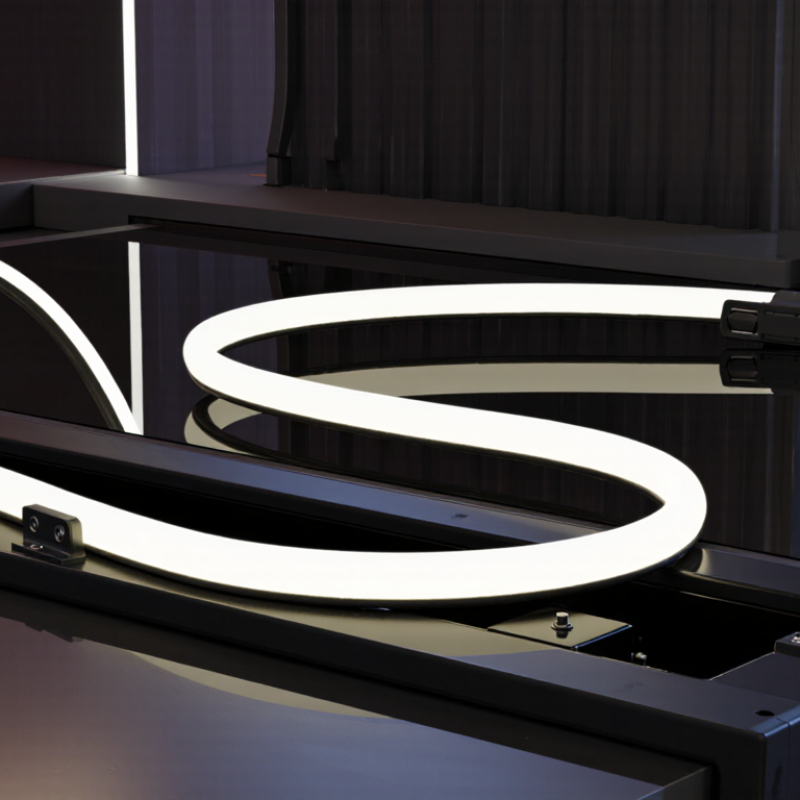
A flex neon strip is a flexible LED light source enclosed in a continuous silicone or polyurethane jacket. Unlike rigid glass neon, it bends around signs, counters, and curved ceilings. Its core structure has four working layers: a flexible printed circuit board, surface-mounted LEDs, a light-diffusing housing, and sealed end components. The housing controls both appearance and protection.
The LED board sets electrical performance. Common options use 12V or 24V direct current, with 24V designs often reducing voltage drop across longer runs. Small copper traces carry current, while cut marks define safe shortening points. A poor cut can damage the seal. It happens more often than installers admit. The diffuser then spreads bright LED points into a smooth neon line. Silicone generally offers strong flexibility, but its bend radius and heat resistance still require checking.
The U.S. Department of Energy reports that LEDs use at least 75% less energy than incandescent lighting and can last up to 25 times longer. That advantage depends on proper heat management and power selection. For outdoor use, an IP rating should be verified under IEC 60529, not assumed from appearance. Top-bend strips suit letters and horizontal curves; side-bend strips fit vertical outlines. The best type depends on the bending direction, viewing distance, color-rendering needs, and installation exposure. A bright sample may look impressive indoors, yet reveal uneven diffusion outdoors.
What Is a Flex Neon Strip and Which Type Is Best?
A flex neon strip is a flexible LED light source enclosed in a continuous silicone or polymer housing. The housing diffuses the light, protects the LED circuit, and determines the strip’s bending direction and durability. LED density is a key structural factor: higher density generally creates a smoother, more dot-free appearance but usually increases power consumption.
The chart shows representative LED densities commonly used in flex neon strip construction. Lower-density strips are suitable for general outlining, while high-density strips are preferred when continuous, uniform illumination is required.
Main Types of Flex Neon Strips and Their Differences
A flex neon strip is a flexible LED light sealed inside a diffusing jacket. It creates a continuous glow, unlike standard strips with visible dots. The main types differ by bending direction, voltage, color, and waterproofing. Top-bend models curve across their width, making them suitable for letters, borders, and straight channels. Side-bend models curve along their length, which helps with circles and narrow architectural edges. Some products support single-color light, while RGB and RGBW versions offer programmable color effects. The choice is practical, not decorative.
Silicone-jacketed neon usually resists heat, moisture, and ultraviolet exposure better than basic PVC designs. However, protection ratings still require careful reading. An IP67 product may tolerate temporary water immersion, but its connectors and cut ends can remain vulnerable. The U.S. Department of Energy reports that LED lighting uses at least 75% less energy and can last up to 25 times longer than incandescent lighting. This supports LED neon’s efficiency, but installation quality still controls real service life. A poorly ventilated channel can shorten it. That detail is often ignored.
Tips: Match the bend direction to the design before ordering. For long runs, 24-volt systems usually reduce voltage drop compared with 12-volt systems. Check the power supply’s continuous output, leaving roughly 20% spare capacity. Measure brightness at the working distance, not only from product photographs. I once favored a brighter strip, yet the reflected glare made the space uncomfortable. That was a useful mistake. For outdoor projects, request test data, sealing details, and working-temperature limits from the supplier.
Key Factors for Choosing the Best Flex Neon Strip
What Is a Flex Neon Strip and Which Type Is Best?
Key Factors for Choosing the Best Flex Neon Strip
A flex neon strip is a flexible LED light enclosed in a continuous silicone or PVC body. It creates an even, neon-like glow without visible bright spots. In real installations, the best choice depends on the setting, not only appearance. Silicone usually handles sunlight, moisture, and temperature changes better. PVC can cost less, but it may age faster outdoors. Check the strip’s bending direction carefully. Some models bend sideways, while others bend vertically.
Brightness, color quality, and protection ratings also matter. For signs, choose consistent illumination and suitable color temperature. For task areas, higher brightness may be useful, but excessive brightness can look harsh. A high color rendering index helps objects appear more natural. Outdoor projects need strong sealing, such as an appropriate IP rating, plus protected connectors. Match the voltage, wattage, and power supply before installation. Heat buildup can shorten service life.
Tips: Measure the full route first. Leave extra length for corners. Test a short section before fixing everything. I once trusted a bright sample and overlooked the connector quality. That mistake caused uneven lighting later. Read the technical sheet, inspect the diffuser, and confirm the warranty terms. A clean installation often depends on small details, not dramatic specifications.
What Is a Flex Neon Strip and Which Type Is Best? - Key Factors for Choosing the Best Flex Neon Strip
| Flex Neon Strip Type | Typical Construction | Typical Voltage | Bending Direction | Typical IP Rating | Best-Suited Uses | Main Advantages | Main Limitations |
| PVC Flex Neon | LED strip enclosed in a flexible PVC diffuser and housing | 12 V or 24 V DC | Usually side-bending or top-bending, depending on profile | IP65 to IP67 is common | Indoor accents, signage, retail displays, architectural outlines | Cost-effective, widely available, easy to install, good color diffusion | Less resistant to UV, chemicals, and extreme temperatures than silicone-based products |
| Silicone Flex Neon | LED strip protected by flexible, UV-resistant silicone extrusion | 12 V or 24 V DC | Top-bending, side-bending, or 3D-bending profiles are available | IP67 to IP68 when correctly sealed | Outdoor façades, landscapes, wet areas, hospitality, long-term installations | Strong weather resistance, flexible, durable, and suitable for smooth continuous light | Usually more expensive; silicone profiles can require compatible end caps and connectors |
| PU Flex Neon | LED strip encapsulated or coated with flexible polyurethane | 12 V or 24 V DC | Profile-dependent; commonly top-bending or side-bending | IP67 or higher in sealed designs | Demanding outdoor environments, curved signage, commercial installations | Good abrasion resistance, strong sealing, and good resistance to some oils and chemicals | Repair and recycling can be more difficult; compatibility must be checked for specific chemicals |
| High-Voltage Flex Neon | LED modules or linear LED assemblies inside a sealed flexible housing | Typically 110–240 V AC, depending on the product | Usually limited to the specified bending plane | IP65 to IP68, depending on construction | Long runs, building outlines, and installations where fewer power feeds are useful | Longer continuous runs and reduced voltage drop compared with low-voltage systems | Requires greater electrical safety precautions and is generally less suitable for close-contact applications |
Key Selection Factors
| Factor | What to Check | Practical Guidance |
| Installation Location | Indoor, sheltered outdoor, exposed outdoor, or underwater use | Use an appropriate IP-rated product, and ensure connectors, end caps, and power supplies have matching protection. |
| Bending Requirement | Top-bending, side-bending, or multidirectional curves | Select the correct profile; bending a strip in the wrong plane can damage the LEDs, circuit board, or housing. |
| Brightness and Power | Lumens per metre, watts per metre, and heat dissipation | Choose brightness for the viewing distance and provide an aluminium mounting channel where heat management is needed. |
| Voltage and Run Length | 12 V or 24 V DC, maximum continuous run, and voltage drop | 24 V systems generally reduce current for the same power and are often preferable for longer low-voltage runs. |
| Cutting and Connection | Marked cut intervals, connector type, and end-cap sealing method | Cut only at marked points and reseal every exposed end for outdoor or wet-location installations. |
| Color and Control | Single color, tunable white, RGB, RGBW, dimming, and pixel control | Match the strip, controller, wiring, and power supply; addressable products need compatible data control. |
| Operating Environment | UV exposure, temperature, moisture, abrasion, and chemical contact | Silicone or PU constructions are generally better choices for harsh outdoor conditions than standard PVC. |
| Safety and Certification | Electrical safety, insulation, flammability, and regional compliance requirements | For public or commercial projects, request current test reports and installation instructions for the exact product configuration. |
Note: Specifications such as IP rating, power, brightness, cut interval, operating temperature, and maximum run length vary by construction and model. Always confirm the exact product datasheet before installation.
Installation, Safety, and Maintenance Considerations
A flex neon strip is a silicone-coated LED circuit shaped like continuous neon tubing. For most architectural signs, silicone LED neon is the practical choice. Top-bend models suit horizontal lettering. Side-bend models follow curves and vertical edges. The best type depends on the installation path. A 24-volt system usually offers steadier performance across longer runs. The U.S. Department of Energy reports that LEDs can use at least 75% less energy and last up to 25 times longer than incandescent lighting.
Plan the route before cutting anything. Measure twice. Never force a tight corner or twist the strip sideways. Respect the stated minimum bend radius. Use the correct aluminium channel, clips, connectors, and power supply. Loose connections can create heat, flicker, or early failure. Outdoor installations need sealed joints and suitable cable glands. Under IEC 60529, IP65 indicates dust protection and resistance to water jets; it does not permit underwater installation. Keep the power supply ventilated and accessible. Mains connections should be handled by a qualified electrician.
Clean the diffuser with a soft, damp cloth. Avoid solvents, abrasive pads, and high-pressure spraying. Inspect joints after heavy rain, heatwaves, or building movement. Flickering often signals voltage drop, poor soldering, or an overloaded driver. The International Energy Agency estimates lighting uses about 15% of global electricity, so efficient operation matters. I have seen installers focus on brightness and overlook heat. That is an expensive mistake. Replace damaged sections quickly. A dim spot may spread. Shorter runs can sometimes outperform one long, poorly fed circuit.


 House of Worship
 Transportation
 Trade shows led display
 retail
 Creative Led Solutions
 Hospitality
 Higher Education
 Corporate LED