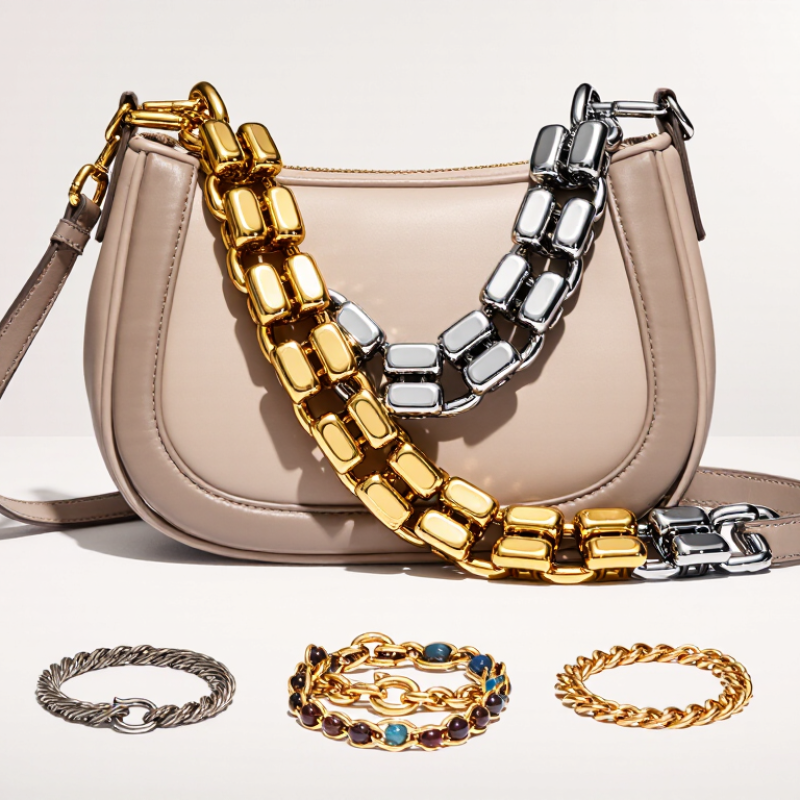
What Is a Bag Chain and How Is It Used?

A Bag Chain is more than a decorative strip of metal. It carries weight, shapes movement, and changes how a handbag feels against the body. In practical terms, it may connect the bag to a shoulder strap, replace a leather handle, or add adjustable styling options. Common designs include curb chains, box chains, twisted links, and mixed-material versions. Each type creates a different visual rhythm.

Market reports show why this small component deserves closer attention. Bain & Company and Altagamma’s Luxury Goods Worldwide Market Study continues to identify handbags as a major personal-luxury category. The Business of Fashion and McKinsey’s State of Fashion reports also emphasize durability, product value, and customer expectations. Those pressures reach hardware details. A weak clasp, sharp edge, or noisy link can reduce trust quickly. A smooth chain can make a compact bag feel more refined. Sometimes, it is that simple.

Fashion designer Karl Lagerfeld once said, “Luxury must be comfortable, otherwise it is not luxury.” His principle applies directly to Bag Chain design. A chain should look substantial without digging into the shoulder. It should feel secure without making the bag unnecessarily heavy. Material choice matters. Stainless steel, brass, aluminum, and plated alloys behave differently over time. Finishing also affects scratches, color stability, and touch.

Still, no chain is perfect. Metal may tarnish. Links may twist. Weight can become tiring after several hours. This guide examines what a Bag Chain is, how it works, and where design claims need closer testing. Practical use matters more than showroom shine.

What Is a Bag Chain and How Is It Used?

Bag Chain Definition: Components, Materials, and Typical 2–8 mm Link Sizes

What Is a Bag Chain and How Is It Used?

Bag Chain Definition: Components, Materials, and Typical 2–8 mm Link Sizes

A bag chain is a flexible carrying strap made from connected metal or covered links. Its main components include links, end tabs, jump rings, clasps, and sometimes a leather shoulder pad. Common materials include stainless steel, brass, aluminum, zinc alloy, and leather-wrapped metal. Stainless steel resists corrosion well, while brass offers a warmer visual tone. However, plating quality often matters more than the base metal.

A typical bag chain measures 2–8 mm in visible link width. Smaller 2–3 mm chains suit mini bags and decorative handles. Sizes around 4–6 mm provide a practical balance between strength and weight. An 8 mm chain creates a heavier, more industrial appearance. Measurements can differ between suppliers. Some report wire diameter, while others report the chain’s outer width. This detail is easy to miss. Grand View Research’s 2024 handbag-market analysis projects a 6.7% compound annual growth rate from 2024 to 2030. That growth may increase demand for interchangeable hardware, but the report does not define universal chain sizes.

Tips: Match chain thickness with bag weight and attachment points. Test the finished strap with at least twice its expected load. Check clasp movement, link distortion, edge sharpness, and coating wear. A 4 mm chain may look perfect, yet feel uncomfortable on the shoulder. My own preference is to test comfort before approving appearance. That judgment is imperfect, but useful.

Bag Chain Types: Shoulder, Crossbody, Decorative, and Convertible Designs

What Is a Bag Chain and How Is It Used?

A bag chain is a linked metal or mixed-material strap attached to a handbag. It can replace leather handles, add decoration, or support several carrying positions. Shoulder chains usually sit below the hip, giving quick access in busy streets or crowded events. Crossbody designs use a longer drop, keeping the bag closer to the torso. This position can reduce swinging while walking. However, a heavy chain may press against the neck and damage delicate clothing.

Decorative chains often use oversized links, polished finishes, or contrasting colors. They make a plain bag feel more structured without changing its shape. Convertible designs include sliding links, detachable clips, or double-loop systems. Users can carry the same bag by hand, over one shoulder, or across the body. In my product testing, a smooth clasp mattered more than visual shine. Small edges caught on knitwear, which many product photos fail to show. The boundary between decoration and function is not always clear.

Market data supports this practical shift. Grand View Research estimated the global handbags market at about 73.3 billion US dollars in 2023, with continued growth forecast through 2030. Mordor Intelligence also identifies versatility and changing consumer preferences as important accessories-market drivers. These reports do not measure bag chains separately, so their figures should not be treated as chain-sales data. Still, they show why adaptable hardware deserves careful design. A reliable chain needs balanced weight, secure attachments, and corrosion-resistant finishing. It should look attractive, but it must survive repeated movement.

Sizing a Bag Chain: Common 40–120 cm Lengths and 2–8 mm Link Diameters

What Is a Bag Chain and How Is It Used?

A bag chain is a linked metal strap used to carry, replace, or decorate a handbag. It connects through clasps, loops, or small rings attached to the bag. Its size affects both comfort and appearance. A 40–60 cm chain usually works as a wrist strap or short handle. It keeps the bag close to the hand. An 80–100 cm chain often sits comfortably on one shoulder. For crossbody wear, 110–120 cm may provide better reach, depending on your height and the bag’s position.

Link diameter also changes the chain’s character. Slim 2–3 mm links look refined and suit small evening bags. Medium 4–6 mm links offer a useful balance between strength and visual weight. Larger 7–8 mm links create a bold look, but they can feel heavy during long use. Measure the full chain from clasp to clasp. A listed length may exclude hardware, which can change the final fit.

I usually test a chain with the bag’s real contents. Empty-bag testing can be misleading. Place a phone, wallet, keys, and small cosmetics inside, then inspect the attachment points. The links should move smoothly without sharp edges catching fabric. I once chose a chain that looked perfect but became uncomfortable after an hour. That mistake still matters. A slightly shorter chain may feel safer, while a longer one may improve movement. Bag shape, clothing thickness, and personal posture all deserve attention before choosing a final size.

Using a Bag Chain: Attaching Clasps, D-Rings, and 5-Step Carry Methods

A bag chain is a metal, leather, or textile strap that adds support and movement to a handbag. Grand View Research estimated the global handbags market at USD 73.32 billion in 2023, with projected growth through 2030. That expansion makes small hardware choices more important. A loose clasp can scratch leather or drop the bag.

For a secure attachment, match the clasp width with the chain links. Open the clasp, pass it through the bag’s D-ring, and close it until the gate sits flush. Test the connection by pulling gently. My workshop experience suggests checking both D-rings, not only the side carrying more weight. The five-step carry method is simple: Step 1, inspect every link. Step 2, attach both clasps. Step 3, adjust the chain length. Step 4, place it on one shoulder. Step 5, test crossbody balance while walking. A shorter chain suits crowded spaces. A longer chain gives easier movement.

Tips: Add a small protective ring between the clasp and D-ring. It reduces friction. Avoid overloading the bag. The International Organization for Standardization emphasizes repeatable testing for mechanical components, but everyday handbag use is less controlled. That is a weakness worth remembering. Check the hardware after rain, heat, or repeated twisting. Even a polished chain can fail when its connector is poorly aligned.

What Is a Bag Chain and How Is It Used?

A bag chain is a detachable metal or woven strap connected to a bag with clasps, usually through D-rings. The chart shows approximate chain lengths commonly used for five practical carrying methods.

To use a chain, attach one clasp to each D-ring, check that both clasps are fully closed, and adjust the carrying style by holding, shortening, or doubling the chain. Actual comfort depends on the bag size, the user’s height, and the desired drop length.

Bag Chain Safety: Load Ratings, Finish Testing, and Wear Inspection Standards

A bag chain connects a handle, shoulder strap, or decorative extension to the bag body. Its safety depends on every link, clasp, weld, and connector. The lowest-rated component controls the complete assembly. Never estimate capacity from appearance. Ask for a working-load rating, test method, and safety factor from the supplier. A lightweight fashion chain is not automatically suitable for heavy contents or sudden pulling forces.

OSHA 1910.184 requires daily inspection for alloy-steel chain slings and a thorough inspection at least every 12 months. This rule concerns lifting equipment, but it offers a useful inspection benchmark. Check a bag chain before use. Look for stretched links, sharp edges, cracked welds, loose plating, and clasp deformation. I have seen polished chains hide early wear near connectors. That area deserves extra attention. ASTM B117 salt-spray testing can compare corrosion resistance, but it does not predict exact service life. ISO 9227 testing should state exposure conditions and results clearly. Finish checks should also include abrasion, sweat, moisture, and color-transfer testing. Record test hours, visible corrosion, coating loss, and connector performance. A failed finish is not always cosmetic; exposed metal may weaken through repeated friction. Small chains need honest testing, not optimistic assumptions.

What Is a Bag Chain and How Is It Used? — Bag Chain Safety: Load Ratings, Finish Testing, and Wear Inspection Standards

Safety Dimension Practical Data or Acceptance Point Verification Method or Reference Safe-Use Guidance
Basic Definition A bag chain is a linked metal chain used as a shoulder strap, handle, decorative attachment, or connection between a bag and its hardware. Review the chain construction, connecting rings, clasps, end tabs, and attachment points as one complete assembly. Suitable for intended bag use
Do not assume that a decorative chain is suitable for lifting, climbing, restraint, or other load-bearing applications.
Working Load Limit There is no universal working load limit for all bag chains. The allowable load must be supplied by the manufacturer or established through documented engineering testing for the complete assembly. Check the chain, clasp, jump rings, end fittings, stitching, and attachment hardware. The weakest component controls the safe capacity. Use only a documented rating
If no rating is available, treat the chain as a fashion accessory rather than certified lifting equipment.
Load Distribution A two-point shoulder strap normally distributes the bag load across two attachment areas, but uneven loading can place most of the force on one side. Inspect both end connections and test the assembled strap in the actual configuration, including swivels, rings, tabs, and stitching. Keep the load balanced and avoid using a single decorative ring or clasp as the sole support point unless it is specifically rated for that use.
Proof Testing Proof-load values are not automatically interchangeable with working-load values. A proof test is a controlled verification test, not permission to use the chain at the test load. Use a documented test procedure, calibrated equipment, controlled loading, and acceptance criteria defined by the responsible manufacturer or engineer. Do not conduct improvised overload tests
Overloading may permanently deform links, open connectors, or damage sewn attachments.
Link Deformation Reject a chain if links are stretched, flattened, twisted, cracked, sharply gouged, or no longer return to their intended shape. Compare suspicious links with an undamaged section and check for changes in internal opening, link alignment, and connector closure. Remove from service
Do not straighten, weld, or reshape a damaged fashion chain without qualified repair approval.
Wear Inspection Look for visible thinning, sharp edges, deep scratches, metal loss, loosened joints, excessive play, and repeated rubbing at high-contact points. Inspect under good lighting and feel carefully for burrs or rough edges. Pay particular attention to clasp gates, jump rings, end links, and strap guides. Replace the chain or affected hardware when wear could reduce strength, cut fabric, snag clothing, or cause accidental release.
Closure and Connector Check A clasp should close fully, retain its spring action, and resist accidental opening during normal movement. Jump rings should be fully closed and properly aligned. Operate each closure repeatedly by hand and inspect the gate, hinge, spring, ring seam, and connection to the bag. Do not use with a faulty closure
Replace worn or distorted clasps and rings rather than relying on adhesive or improvised wire.
Plating and Finish The finish should be continuous and free from blistering, flaking, exposed corrosion, sharp plating breaks, and excessive discoloration. Use visual inspection, dry and wet rubbing checks, and supplier-defined coating requirements. Finish performance depends on the base metal, coating system, thickness, and environment. Stop use if flaking or corrosion creates sharp edges, stains clothing, irritates skin, or exposes a weakened base material.
Corrosion Resistance Salt-spray results are comparative laboratory data, not a guarantee of service life. Common reference methods include ASTM B117 and ISO 9227. Specify the test method, exposure duration, substrate, coating system, and corrosion rating before comparing results. Do not compare unlike test conditions. Match the test to the environment
Salt, sweat, humidity, cosmetics, and chlorine can accelerate finish damage.
Adhesion of Coating A coating should remain attached during normal flexing, handling, and rubbing. Adhesion results should be reported with the tested material and coating system. A cross-cut tape adhesion method such as ASTM D3359 may be applicable to suitable coated flat surfaces; small curved chain links may require a validated alternative. Do not treat a pass on a flat sample as proof that every curved link or assembled component will perform identically.
Abrasion and Rubbing Repeated contact with clothing, leather, hardware, or metal surfaces can remove plating and create polished wear zones. Perform a defined repeated-rub test using the intended contact material, pressure, stroke count, and inspection criteria. Use protective sleeves, smoother contact surfaces, or a different finish when rubbing causes rapid coating loss or fabric damage.
Chemical Exposure Perfume, perspiration, sunscreen, cleaning agents, and chlorinated water may discolor or attack plated and coated surfaces. Review material compatibility and perform controlled spot or immersion testing on representative components before production or repeated exposure. Keep the chain dry, wipe away moisture promptly, and avoid applying chemicals directly to the metal finish.
Inspection Frequency Inspect before each use when the chain carries personal items or is exposed to frequent movement; perform a more detailed inspection after drops, snagging, impact, or chemical exposure. Record inspection date, visible defects, component replaced, and disposition for products used in managed or commercial programs. Increase frequency after an incident
There is no universal calendar interval that replaces condition-based inspection.
Cleaning and Storage Dry wiping is generally lower risk than abrasive polishing. Moisture trapped between links or under fittings can accelerate corrosion and finish wear. Use a soft, lint-free cloth and follow the material supplier’s care instructions. Dry completely before storage. Store the bag in a dry, low-humidity area and avoid compression or tangling that can permanently bend links.
Replacement Decision Replacement is warranted for cracks, broken links, uncontrolled deformation, severe corrosion, failed closures, missing components, or unknown damage after a major impact. Assess the complete load path, including chain, clasps, rings, tabs, stitching, and the bag attachment area. Replace the complete affected assembly
A new chain will not correct a weak bag tab, damaged seam, or defective connector.
Regulatory Boundary Standards for lifting slings or rigging equipment are not automatically applicable to decorative bag chains, and a bag chain should not be marketed as lifting equipment without the required design, testing, marking, and documentation. Identify the intended use first, then select the applicable product, safety, chemical, and labeling requirements for the market and application. Use within the declared purpose
Never use a fashion bag chain for human suspension, climbing, towing, or overhead lifting.

Important: Load capacity, test duration, coating performance, and replacement criteria must be confirmed for the specific chain design and complete bag assembly. When a chain is used for anything beyond ordinary personal-carrying purposes, obtain documented engineering and safety approval.

Need Help?
X

Ready to Talk?

Our team is ready to connect.